

How to reduce bias in hiring interviews
By Emmanuel Vasilakis · Published · 4 min read
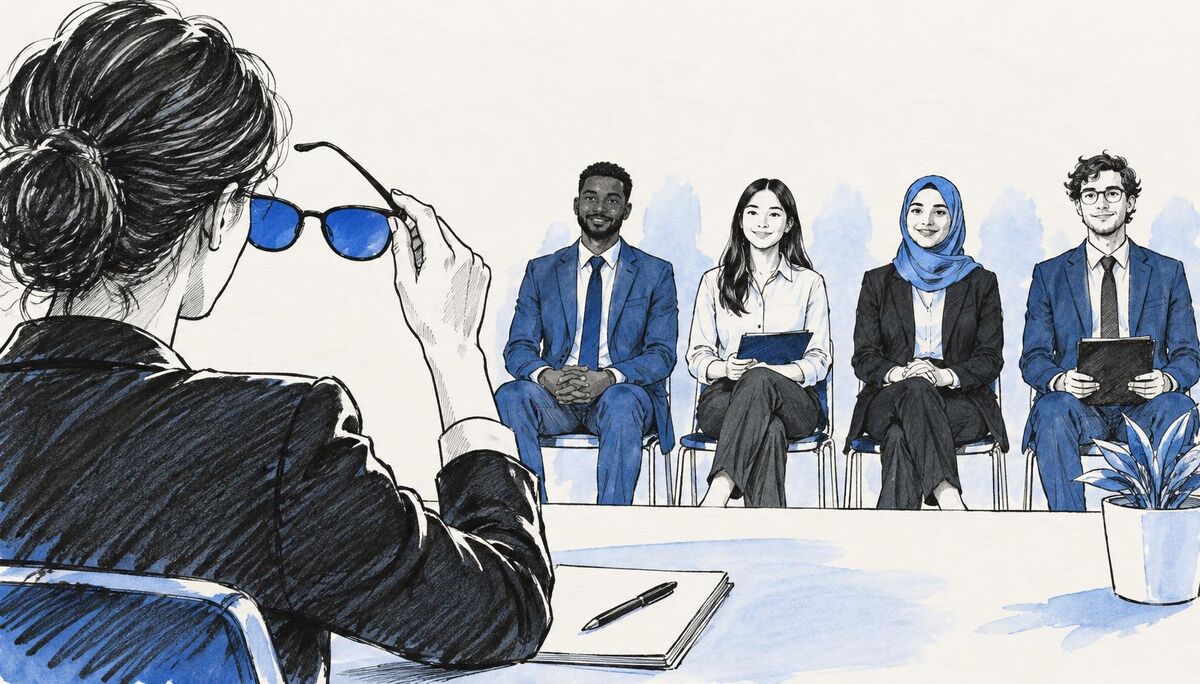
The most reliable way to reduce bias in interviews is to change the process, not to rely on people noticing their own biases. Ask every candidate the same job-related questions, score each answer against a written guide, have interviewers score alone before discussing, and decide what the job needs before you meet anyone. Awareness training can help people understand bias, but on its own it rarely changes hiring decisions. Structure does.
Common interview biases
| Bias | What happens | Example |
|---|---|---|
| First impressions | An early judgement colours everything after | A nervous first minute leads to a low score overall |
| Confirmation | Interviewers look for evidence that supports their first view | Probing hard on weaknesses only for candidates they doubt |
| Similarity | Preferring people like ourselves | Warming to a candidate from the same university |
| Halo and horns | One strong or weak trait affects all ratings | Great presentation skills raise the score for analysis too |
| Contrast | Judging a candidate against the previous one | An average candidate seems strong after a weak one |
| Stereotypes | Assumptions based on group membership | Assuming a parent cannot travel |
Why awareness alone is not enough
Most biases work quickly and without our noticing. Knowing they exist does not stop them in the moment. Process changes work because they reduce the room for bias to act: everyone gets the same questions, answers are compared with the same standard and scores are recorded before group discussion.
Ten steps that reduce bias
- Define the job first. Agree the four to six skills that matter before you see any CVs.
- Write the questions in advance. Same questions, same order, for every candidate.
- Write scoring guides. Describe weak, average and strong answers for each question.
- Remove unnecessary information from CVs at screening where you can, such as photos, dates of birth and addresses.
- Use a work sample where possible: a short task like the real job.
- Use more than one interviewer and, where you can, a mix of backgrounds.
- Take notes on evidence, what the candidate said or did, during the interview.
- Score straight after each interview, alone, before talking to anyone.
- Discuss skill by skill in the debrief, with the most senior person speaking last.
- Review your data. Look at who applies, who is interviewed and who is hired. Gaps can show where the process needs work.
Questions to avoid
Ask only what relates to the job. Questions about age, family plans, marital status, religion, health, ethnicity, sexual orientation and similar topics do not predict performance, and in the EU, discrimination on many of these grounds in hiring is unlawful. If you need to know whether someone can meet a job requirement, such as travel or shift work, ask everyone the same way: "The role needs travel two weeks a month. Is that something you can do?"
This is general information, not legal advice. Employment law differs between countries: check with an employment lawyer or HR adviser.
An example
A software company in Athens notices that its interview panels rate candidates very differently. It introduces written questions and scoring guides, asks each interviewer to submit scores before the debrief, and adds a 45-minute work sample. After two hiring rounds, interviewers' scores for the same candidate are much closer, and the team spends less time arguing in debriefs.
What the evidence says
That structured interviews reduce the effect of interviewer bias and are fairer across groups than unstructured ones is Strong. That bias awareness training alone changes hiring decisions is Weak: studies often show short-term changes in attitudes but little lasting change in behaviour. That removing identifying information at screening reduces bias is Mixed: results vary by setting. Work samples predicting performance well is Strong.
Frequently asked questions
How do you reduce bias in interviews? Use the same job-related questions for every candidate, score against written guides, have interviewers score alone and decide what the job needs before you start.
Does unconscious bias training work? On its own, rarely. It can raise awareness, but research shows little lasting change in decisions unless the process changes too.
What are examples of interview bias? First impressions, confirmation bias, preferring people similar to you, halo effects, contrast with the previous candidate and stereotypes.
Check yourself
- Why do process changes work better than awareness alone? They reduce the room for bias to act, regardless of whether people notice it.
- What is the contrast effect? Judging a candidate against the previous one rather than the standard.
- How should you ask about a job requirement like travel? The same way for every candidate, tied to the job.
Go deeper: free sample lesson
The Structured Interviewing course covers interview bias and the process changes that reduce it. Read the free sample lesson
Related guides
- Structured interview questions, with a scoring guide
What a structured interview is, how to build one in five steps, 20 example questions by competency, a 1 to 5 scoring guide with anchored answers and the mistakes to avoid.
- Behavioural interview questions and how to score the answers
What behavioural interview questions are, 15 examples, how to probe for real detail, how to tell a strong answer from a rehearsed one, and a worked scoring example.
- Interview scorecard template, with a worked example
A copyable interview scorecard template: what to include, how to weight skills, set minimum scores, combine several interviewers' ratings and run a fair debrief.
- How to hire salespeople: interview questions and a scorecard
Interview questions for hiring salespeople, a role-play exercise, and a scoring sheet with examples of weak and strong answers, built on what predicts performance.