

Interview scorecard template, with a worked example
By Emmanuel Vasilakis · Published · 3 min read
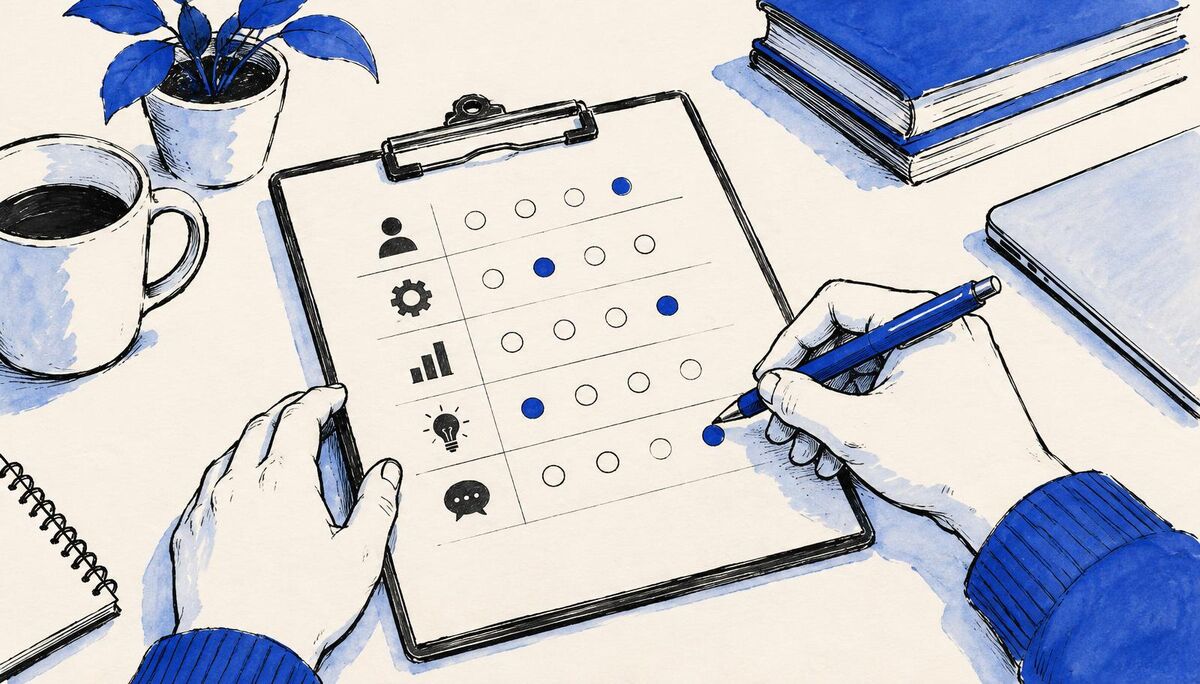
An interview scorecard lists the skills a job needs, the questions that test each one, a 1 to 5 rating scale with written anchors, and space for evidence. Each interviewer fills it in alone straight after the interview. Weight the skills by importance, set a minimum score for the essential ones, and only then add up a total. The scorecard turns impressions into evidence and makes candidates comparable.
What a scorecard includes
- Role and candidate details.
- Skills to assess, usually four to six, each with a weight.
- The questions for each skill.
- A rating scale with a short description of 1, 3 and 5.
- Evidence notes: what the candidate said or did, not your opinion.
- A minimum score for each essential skill.
- An overall recommendation, made last.
The template
- SkillWeight Questions Evidence (what they said or did) Score (1 to 5) Minimum
- [Skill 1] [ ]%[Q1, Q2][3]
- [Skill 2] [ ]%[Q3, Q4][3]
- [Skill 3] [ ]%[Q5, Q6][ ]
- [Skill 4] [ ]%[Q7, Q8][ ]
A worked example
Role: customer success manager. Four skills, with weights that add up to 100%.
| Skill | Weight | Score | Weighted |
|---|---|---|---|
| Customer handling | 30% | 4 | 1.2 |
| Problem solving | 30% | 3 | 0.9 |
| Communication | 20% | 5 | 1.0 |
| Planning | 20% | 2 | 0.4 |
Total100%3.5
The weighted score is 3.5 out of 5, which looks fine. But planning is an essential skill with a minimum of 3, and the candidate scored 2. The minimum rule flags the gap, so the panel discusses it with evidence rather than letting a strong communication score hide it.
Combining several interviewers
When two or three people interview the same candidate:
- Each scores alone, before talking to anyone.
- Average the scores per skill. Example: planning scores of 2, 3 and 2 give an average of 7 ÷ 3 ≈ 2.3.
- Discuss large gaps. If one person gives 5 and another gives 2, ask each for their evidence. Often one of them saw something the other missed.
- Change scores only on evidence, not on persuasion.
Running a fair debrief
- Everyone submits their scorecard first.
- The hiring manager speaks last, so seniority does not set the tone.
- Go skill by skill, not "so, what did everyone think?"
- Record the decision and the main reason.
Common mistakes
| Mistake | Fix |
|---|---|
| Writing "good culture fit" as evidence | Write what the candidate said or did |
| Filling in the scorecard the next day | Fill it in within an hour |
| Changing the skills between candidates | Fix them before the first interview |
| Recommending first, scoring later | Score each skill, then recommend |
What the evidence says
That combining ratings mechanically (adding weighted scores) predicts performance better than overall judgement is Strong, from decades of research on mechanical and holistic decisions. That scoring alone before discussion reduces group pressure is Mixed, supported by research on group judgement. The template is Practice.
Frequently asked questions
What is an interview scorecard? A form listing the skills a job needs, the questions for each, a rating scale with anchors and space for evidence, filled in by each interviewer alone.
How do you weight an interview scorecard? Give each skill a percentage by importance so the weights add up to 100%, multiply each score by its weight and add them up.
Should a high total always mean a hire? No. Set minimum scores for essential skills so a strength in one area cannot hide a gap in another.
Check yourself
- A skill weighted 30% is scored 4. What is its weighted score? 1.2.
- Why set minimum scores? So a high total cannot hide a gap in an essential skill.
- Who should speak last in a debrief? The hiring manager.
Go deeper: free sample lesson
The Structured Interviewing course covers scorecards, combining ratings and running debriefs. Read the free sample lesson
Related guides
- Structured interview questions, with a scoring guide
What a structured interview is, how to build one in five steps, 20 example questions by competency, a 1 to 5 scoring guide with anchored answers and the mistakes to avoid.
- Behavioural interview questions and how to score the answers
What behavioural interview questions are, 15 examples, how to probe for real detail, how to tell a strong answer from a rehearsed one, and a worked scoring example.
- How to reduce bias in hiring interviews
The common biases in hiring interviews, why awareness training alone rarely fixes them, and ten process changes that do, from structured questions to independent scoring.
- How to hire salespeople: interview questions and a scorecard
Interview questions for hiring salespeople, a role-play exercise, and a scoring sheet with examples of weak and strong answers, built on what predicts performance.